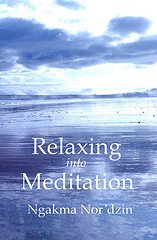
What exercises and practices will help us to live a life free of stress? Ngakma Nor’dzin, a Western Buddhist Lama, guides us through relaxation and breathing exercises that lead into meditation. The meditation methods are described in friendly and accessible language, and will enhance the lives of those who practise them. Ngakma Nor’dzin regards meditation as a life skill that creates happier and more fulfilling relationships, and increases well-being and psychological health. Relaxing into Meditation draws on her experience teaching in community education. Ngakma Nor'dzin teaches internationally and is also the author of Spacious Passion, an introduction to Buddhist practice.
Available formats
Reviews
This is a wonderful introduction to relaxation and meditation - its message offers peace and tranquillity in this stressful world.
— Joanna Lumley
The title of the book sounds very inviting: Relaxing into Meditation. But I guess I always reserved a bit of apprehension about the book itself, specifically because my experiences with classroom practices in meditation have usually involved me quickly trying to “get it” before everyone else begins. Invariably, the teacher needs to move on, and I'm found later sitting there still trying to figure it out (Am I sitting comfortably? Am I sitting upright and comfortably? Should I be comfortable or uncomfortable? Am I meditating?) instead of applying myself to this practice of meditating.
However, this book was written very much for the common person—like myself—who needs a bit of longhand instruction, practice at doing it, repetitive language to ease the transition into a new kind of practice, and a patient and uniform tone (although not a monotonous one).
This read was not only an easy one, but a very compassionate, economical one: I was able to read it, stop for a moment to practice what was suggested, then go back to reading without some word, term or complicated passage tripping me up. In fact, to ease the process of learning the author even suggests that some exercises are easier than they sound (a clear indication of time spent with visual and practice-based learners), and suggests that the uninitiated have someone read it to them when possible. The patience and accessibility of the information is one of the highlights of the book throughout.
In addition, the inspired italicized passages describing the author's classroom environment allowed me a window into the practice done over time and within different kinds of environments, and with different kinds of people. Strangely enough, those descriptions seemed to help me connect up with the practice much like I do when I am in a classroom. I suppose that, in reading the passages, I imagined the support of others around me doing the exercises too.
The content itself I found helpful as well. There are expository passages, such as the suggestions for singing, that speak to societal and personal pressures that keep us inhibited about practices that are possibly life-sustaining for us. I feel the short-handed written reasoning about such matters—without being overly negative about societal—or our self-induced pressures - helps us to gain some compassion for ourselves out there. The practices themselves, along with the philosophy behind them, simply offer an alternative to the current practices - an alternative that has the potential to be so much more helpful to our minds and bodies.
I appreciate the opportunity to be the first to experience this easy to follow, supportive book.
— Kamili Feelings, Writer.
Ngakma Nor’dzin’s training in meditation began three decades ago under the guidance of Tibetan teachers, culminating in her ordination into the non-monastic tradition of Nyingma Tibetan Buddhism. She is, in fact, the first Western woman to achieve such a distinction. She and her husband, Ngakpa ’ö-Dzin Tridral, have run a local meditation group for more than twenty years. And this is how she starts this book–with a meditation group. Her concern with bringing the presence of meditation to a wider audience is clear. She believes that “[i]f everyone meditated for a few minutes every day, the world would be a more peaceful and friendlier place”.
Nor’dzin begins Relaxing into Meditation with relaxation and breathing techniques specifically aimed at creating relaxation of the body and calmness of mind before embarking on a description of meditation practices which may be more demanding. As she believes that it is preferable to have obtained some relief from pain before beginning meditation, she starts the book with relaxation techniques to allow us to arrive at a starting point for meditation. She advocates using an aural guided narration to facilitate one’s progress through the various exercises that she describes.
Nor’dzin’s teaching background is clearly evident throughout the text in the systematic and logical way in which she presents her material. Each chapter starts with a description of the meditation group performing the activity which she then goes on to describe. Before explaining how to practice the technique, she discusses the importance and relevance of doing so. Nor’dzin also advises one on how to cope with any difficulties that one encounters with the exercise. Her years of experience with teaching others in small group settings, as well as individually, have enabled her to gain insight into what difficulties these might be, and she has evolved ways of dealing with any such problems, which she shares with us, her readers. Although she writes about a subject that others have been prone to mystify and deliberately, it often seems, obscure, she writes in such an accessible and approachable way that you are drawn to listen avidly to what she has to say. She is, in fact, overwhelmingly kind and gentle in her approach, so that, no matter your age or background, you are likely to be comforted and inspired by her work.
Relaxing into Meditation is well illustrated with line drawings throughout, and ends with a glossary, which expands on some of the more unusual terms to be found in the text, though such terms are relatively few, and an easy-to-read index. As someone who is only now, in her mid-fifties, starting to become more aware of how to treat herself and her own body with kindness, I can definitely recommend the timely wisdom of this book. No matter your age, do consider acquiring a copy for yourself–it should be well worth it.
— Lois Henderson
If you’re anything like me, you'll find instruction manuals on how to assemble flat-pack furniture, 99% of all legal documents and those software agreements that pop up on your screen when you've just installed a new programme damn difficult to understand. Thankfully Ngakma Nor’dzin’s wonderful book, Relaxing into Meditation is concise, to the point, easy to read, and most importantly (for me) easy to understand. Many different relaxation and meditation techniques are explained via short digestible chapters and encouragingly, not once did I feel, ‘this is beyond me’, If anything, I found myself spontaneously experimenting with the exercises and suggestions and taking heart from their accessibility and the feelings of well-being they induced. Excuse me now, I've got some relaxing to do.
— Maynard O’Byrne
Relaxing into Meditation is the best book on meditation I've ever read, and I've been browsing them since the mid-70's. I say this because of the distinction made between relaxation and meditation, and the explanation of why relaxation must happen before meditation can begin. I have never seen it spelled out so clearly before, and in such a gentle, non-didactic manner. The writing draws you in and you come to love the teacher as if you were also a member of one of her meditation groups. I love that the chapters are short and not overwhelming. The author doesn't talk down to the reader and isn't too folksy. It is simple, but not “meditation for dummies.”
Some years ago I was watching a cable-access show presented by one of the guru-types that so frequently make appearances on such venues. One thing he mentioned came through loud and clear. In his discussion on meditating the guru explained that one can't just jump into meditation and expect it to “work.” Rather, he said that “the secret” is that your focus should be on “becoming meditative” rather than “meditating.” That is, if you stop putting the emphasis on attempting to have the perfect meditation experience and just relax by performing the preliminaries, a meditative state will come upon you in a natural, non-forced manner.
This struck me, for having read various meditation books through the years I would become motivated to practice but would stop and start, becoming bored or frustrated with my lack of “progress.” Thus, hearing about the idea of not trying so hard at it, but just relaxing into "becoming meditative" was very appealing. Unfortunately, I never saw that presenter's show again so I never learned what it meant to “become meditative” – that is, until I read Relaxing into Meditation.
The beauty of the text is in the presentation of the ways of becoming meditative, i.e. through breath-work, song or movement. Each exercise is enough in itself. There is no pressure to move on to the next technique, and the benefits of each level are given respect. That is not to say one is not invited to try other meditative techniques, just that each one is whole and respected in itself.
The illustrations of the text along with the warm and friendly manner in which it is written make attempting each new meditative technique a real pleasure. This is a fabulous book for those who have been curious about meditation but were a little hesitant, feeling they didn't have “the right stuff” to be successful at it. The text is gentle and fun and calmly inspiring, and even if you have dabbled in meditation before you'll learn new ways to think about what you have been doing. Relaxing into Meditation is sure to become a classic.
— Rossinna Ippolito, Indexer.
Ngakma Nor’dzin takes you gently by the hand and with her you embark on a journey towards Openness, Kindness and Awareness. I found the warmth and ‘human-ness’ of her writing both refreshing and inspirational.
— Yé-tsal Khandro